Re: Tail brace rods.
That's great! What is the part number and lengths? I have brand new wires on my 41 and would change them out tomorrow for rolled SS wires.
Can you reuse the end fittings and jam nuts or do you need new ones (the old ones have that goofy thread that is hard to find). If I was making these new I would go to a regular thread.
I can't see a donnybrook from a new manufacture wire that is better. All anyone was saying was the original ones were steel and had cut threads. I DON'T like them. I would rather get new ones from Univair and not have to worry about them.
Hank
By the way, YES, the washers have a slightly larger hole to fit over the tube and keep the fitting from bearing on the bolt. The flat wrapped steel end piece with the bolt bears on the TUBE, not the fastener and the fitting can rotate if the wire isn't in place. This allows the load to go straight down the wire and not apply a bending load in the threads.
-
Re: Tail brace rods.
The rods I bought from Univair are Stainless Steel. (and incidentally, they have rolled threads, not to start a donnybrook).Leave a comment:
-
Re: Tail brace rods.
In other threads there was reference to what I believe were special washers--with some kind of collar--to be used on the bolts that fasten the brace rod straps to the stabilizers. I recall some reference to the potential of the bolts being cut if incorrect washers were used.
Are there special washers needed here? If so, is there a drawing or better yet a picture of the correct washers? I have drawings that give a part number but there is not enough detail in the drawing to show what the washer looks like exactly.
BlakeLast edited by blakecarl; 02-17-2010, 10:10. Reason: clarify and revise to terminology used in drawingsLeave a comment:
-
Re: Tail brace rods.
MEASURE your wires before you order! Different years have different lengths. My 41 and 45 wires ARE NOT interchangeable!
Hank
Don't forget to get jam nuts. ;-)Leave a comment:
-
Re: Tail brace rods.
Tailbrace Wire (Top) 441/8 inches ............UD-40 ..... Stainless Carb Box ...
.......D1729. PC 665. * The above items are intended for individual owners or
operators to facilitate maintaining of their aircraft. Qualified maintenance ...
http://univairparts.com/pdfs/taylorcraft_mannual.pdf - 28k - Similar pages
just click here - D&E Aircraft - Parts, Wings, Ribs and other ...
Taylorcraft Type Cove. $60.00 ea. 310-009. Riblett GAU Cove. $60.00 ea ...
Stainless Drag Wire 30". $22.00 ea. 302-360. Stainless Drag Wire 36". $22.00 ea
...
http://www.de-aircraft.com/order-p.html - 38k - Similar pages
Parts Photo Gallery - D&E Aircraft - Parts, Wings, Ribs and other ...
Stainless Drag / Anti Drag Wires, with Rolled Threads & Lots of Sizes. ... For
Riblett 56", 63",66" & Taylorcraft Aircraft. Trailing Edge Pre-Formed 10' ...
http://www.de-aircraft.com/partsgallery.html - 25k - Similar pagesLeave a comment:
-
Re: Tail brace rods.
Does anyone make stainless steal wires I live close to the Gulf and my wires are pitted and need replacing. About every Champ in this part of the country has been refitted with SS and they look and work great. Seems like someone in Alaska was building these does anyone remember who? MikeLeave a comment:
-
Re: Tail brace rods.
Why are we rehashing this again? in the previous discussions the original wires are CUT threads and if you need replacements Burls has them under stc, you will need to send him your spoke nuts for modification per his STC.Leave a comment:
-
Re: Tail brace rods.
While we are talking about the safety of the tail wires, what about those two little tabs on the bottom where the "brackets" attach. I can see those having corrosion or cracks under the paint and or dirt.
I am pretty sure that I found that the tailwires originally were 90K lbs/in2 steel with rolled threads. Years ago I was considering cad plating mine. Bad Idea, without post plating out-gassing treatment. Don't remember where I got the strength information, but it was pretty solid and I get this feeling that the factory was involved. We're talking in the 80's.
Anyway check those tabs with all the other stuff.
DCLeave a comment:
-
Re: Tail brace rods.
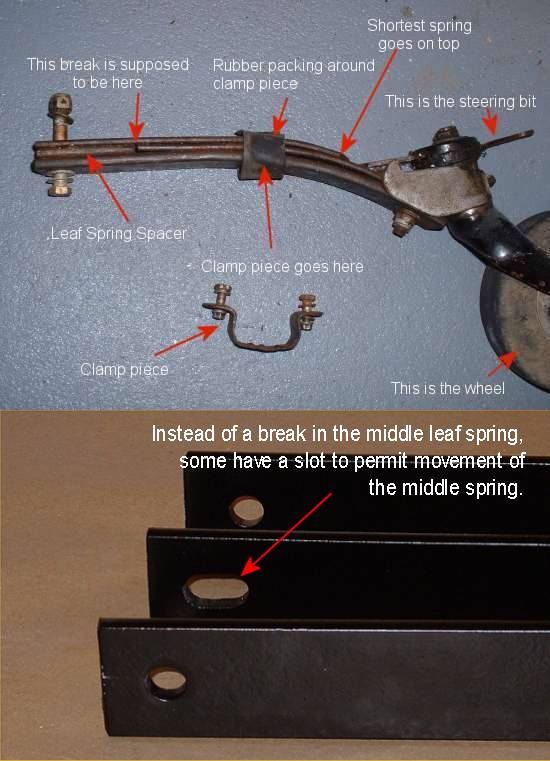
The break or a slot should work, but I have never seen them personally. The key is there can't be a solid lock between any two leaves. Not sure I like the slot since you can't tell you don't have a pair of the bottom springs without taking them apart.
The only reason I put the spring discussion with the tail wires is I always look at both at the same time. As you have noticed, there is another thread on the tail springs. Both topics should be looked at by every Taylorcraft owner. Cheap insurance against catastrophic consequences.
HankLeave a comment:
-
Re: Tail brace rods.
Not quite sure whether you posted this in the right thread, Hank, but whilst we're on the subject, some leaf springs have a slot to permit movement...see the bottom of this picture.Originally posted by Hank Jarrett View Post
Rob
Leave a comment:
-
Re: Tail brace rods.
Not knowing the original spec I can't tell you the loads, but the standard wires are WAY over strong for any loads that would cause failure of other parts in the tail. That is the WIRES are way over strong. The cut threads will cause huge stress concentrations and any failure will come in the threads. I have seen tail wires with some pretty nasty corrosion pits that were flying just fine and the lower ones can take quite a hit from debris or obstacles on the ground. Ever seen anyone grab the top wires to pull an airplane back? Makes my hair stand on end, but I have seen it done to many times to count.
A few things to remember since I can't answer directly without looking at the original factory design calculations.
The horizontal tail lifts DOWN in normal flight. Moving the elevator down can reverse the force if it is pushed far enough (loading the lower wires), but if a top wire fails the stab will probably bend and fold down followed by the plane diving into the ground with a locked elevator. Not a good day.
If you don't have the jam nuts on and tight, vibration can cause the threaded fittings to turn in the strap fittings changing the rigging or the wire can come completely loose. Same bad day.
If you don't put your hand on the wire (checking for a low "thrum" when plucked) and check each jam nut for not being loose, ALL 8, you won't know if the nuts are tight and the wires rigged. Leading eventually to the "bad day".
If the wires have pits along the length, there can be stress corrosion as bad or worse than the cut threads cause, leading to the "bad day".
If there are pits, cracks or corrosion under the covered part of the threads, you can get an "unexpected bad day", and you aren't allowed to look at that part without your A&P! Take them apart at the annual and LOOK AT THEM WITH A MAGNIFYING GLASS! Then treat them with a coating to keep water out and prevent corrosion.
As far as I know there hasn't been a failure of a tail wire that caused a crash. Of course there hadn't been a strut failure that caused one either, and from what I have seen there STILL hasn't been a strut failure, but that didn't stop all of us from being grounded. This is easy stuff to check guys (except the thread inspection). Just get used to doing it on every preflight. You need to be checking the tail wheel and springs on every preflight anyway, and a failure there is likely to only mess your pants and bend the plane.
Hank
PS
To get to the basis of Bill's question, Forrest would need to answer, but if I was making SS wires with rolled threads and didn't have the original data I would just do a hardness and conductivity test on the original wire to determine it's tensile strength (along the middle part) then select a SS wire that was at least as strong and roll threads on it. That would make the new wires at LEAST as strong along the length and MUCH stronger in the threads. It would require all new end fittings and an STC, but would probably never need be a worry again.
By the way, I would also change the design of the end fittings so they could be safety wired and couldn't vibrate loose. The fitting also needs a cross hole to insure minimum thread engagement.Leave a comment:
-
Re: Tail brace rods.
Question based on idle curiosity: How much loads are on those wires, and how much strength does the original style steel rod have? In other words, how far overkill are the original brace wires?Originally posted by Hank Jarrett View PostLeave a comment:
-
Re: Tail brace rods.
Aaron,
On my 41 there was just a couple of steel washers. The 45 had the original square piece of steel with a hole in it. You need the spacer to keep the top and bottom springs parallel. Notice that the top spring runs from the front bolt to the strap. The second spring runs from just aft of the washers down to the tailwheel. The third spring is the only one that runs from the front bolt all the way back to the tail wheel. If you have two springs from the front bolt to the tail wheel when you push down on the tail (like when the tail drops on a normal landing) there is a shearing effect and one of the two bolts eventually gets sheared off. Lots of Taylorcrafts out there with the springs in the wrong order or the wrong springs. These are planes just waiting to loose the tail wheel assembly. I learned this one the hard way. It WON'T last with the springs wrong. If they are wrong, you are on borrowed time. Without the washers the top and bottom spring are pinching the middle one and the same thing can happen.
Hank
Yes, I also like cotter keys better than self locking nuts. Very few elastic or JAP nuts on my planes.Leave a comment:
-
Re: Tail brace rods.
I guess I would need whatever the wire braces thread into that connects them to the vertical and horizontal stabs. I have the threaded (bosses??) on the stabilizers, but nothing to go in between them.
If you have anything that would help me, I'd be glad to buy them from you.
Thanks again....
AaronLeave a comment:
-
Re: Tail brace rods.
Burls aircraft sells them under a pma or stc, look him up on the web. Tim
Leave a comment:


Leave a comment: